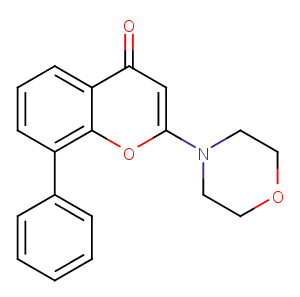
LY294002

CAS号

154447-36-6

分子式

C19H17NO3

主要靶点

Apoptosis|PI3K|Autophagy|DNA-PK|Casein Kinase

仅限科研使用

Cat No : CM00342

Print datasheet

Synonyms

Apoptosis|CNE-2Z|Casein Kinase|carcinoma|CaseinKinase|broad-spectrum|Autophagy|inhibit|Human|DNA-PK|DNAPK|DNA-dependent protein kinase|translocation|tumor|YAP|spermatozoa|SF1101|SF-1101|SF 1101|reversibly|Phosphoinositide 3-kinase|PI3K|p110α|p110β|p110δ|nuclear|NSC697286|NSC-697286|NPC|NSC 697286|nasopharyngeal|Inhibitor|LY 294002|Leptin|Lysophosphatidic acid|LY-294002|LY294002


产品信息

CAS号 154447-36-6
分子式 C19H17NO3
主要靶点 Apoptosis|PI3K|Autophagy|DNA-PK|Casein Kinase
主要通路 代谢|干细胞|凋亡|DNA 损伤和修复|PI3K/Akt/mTOR 信号通路|PI3K/Akt/mTOR 信号通路|自噬
分子量 307.34
纯度 99.96%, 此纯度可做参考,具体纯度与批次有关系,可咨询客服
储存条件 Powder: -20°C for 3 years | In solvent: -80°C for 1 year | Shipping with blue ice.
别名 Apoptosis|CNE-2Z|Casein Kinase|carcinoma|CaseinKinase|broad-spectrum|Autophagy|inhibit|Human|DNA-PK|DNAPK|DNA-dependent protein kinase|translocation|tumor|YAP|spermatozoa|SF1101|SF-1101|SF 1101|reversibly|Phosphoinositide 3-kinase|PI3K|p110α|p110β|p110δ|nuclear|NSC697286|NSC-697286|NPC|NSC 697286|nasopharyngeal|Inhibitor|LY 294002|Leptin|Lysophosphatidic acid|LY-294002|LY294002

靶点活性

p110α:0.5 μM (cell free)|DNA-PK:1.4 μM (cell free)|p110δ:0.57 μM (cell free)|p110β:0.97 μM (cell free)

体内活性

方法:为检测体内抗肿瘤活性,将 LY294002 (25 mg/kg,每周两次) 和 cisplatin (5 mg/kg,每周一次) 腹腔注射给携带人胰腺癌肿瘤 AsPC-1 的 BALB/C nu/nu 小鼠,持续三周。 结果:对照组小鼠的肿瘤体积增加,而 cisplatin 或 LY294002 治疗组的肿瘤体积分别减少为 77% 和 70%。联合治疗组更有效,肿瘤体积的生长下降到对照组体积的 44%。[4] 方法:为研究 PI3K 的药物阻断是否能改善 LPS 诱导的小鼠急性肝损伤的发展,将 LY294002 (40 μM; 10 μL) 单次腹腔注射给 LPS 诱导的急性肝损伤 BALB/c 小鼠模型。 结果:LPS 诱导的肝炎中,LY294002 治疗明显抑制了各种疾病相关促炎细胞因子的肝内合成,包括肿瘤坏死因子-α、IL-6、IL-1β 和 INF-γ。在 LPS 损伤的小鼠肝脏样本中,观察到 LY294002 显著抑制 IκB 磷酸化。因此,LY294002 可能通过抑制活化的 B 细胞依赖性信号通路的 IκB 核因子 κ 轻链增强子来保护肝脏免受 LPS 诱导的损伤。[5]

体外活性

方法:人胰腺癌细胞 AsPC-1、BxPC-3 和 PANC-1 用 LY294002 (5-45 μM) 处理 24 h,使用 MTT 方法检测细胞生长抑制情况。 结果:LY294002 剂量依赖诱导 AsPC-1、BxPC-3 和 PANC-1 细胞生长,IC50 分别为 40 μM、5 μM 和 35 μM。[1] 方法:表达人胰岛素受体的中国仓鼠卵巢细胞 CHO-IR 用 LY294002 (5 μM) 处理 5 min,并用 Insulin (1 nM, 10 min) 刺激,使用 Western Blot 方法检测靶点蛋白表达水平。 结果:LY294002 可阻断 CHO-I R细胞中胰岛素诱导的 PKB Ser473 磷酸化。[2] 方法:人鼻咽癌细胞 CNE-2Z 用 LY294002 (10-75 μmol/L) 处理 24-48 h,使用 Flow Cytometry 方法检测细胞凋亡情况。 结果:LY294002 剂量依赖性诱导 CNE-2Z 细胞凋亡。[3]

溶解度

DMSO:61.46 mg/mL (200 mM); H2O:< 1 mg/mL (insoluble or slightly soluble); Ethanol:10 mg/mL (32.54 mM)

细胞实验

The cells were seeded into 96-well plates at 5000 cells/well. Twenty-four hours after cells were seeded, the medium was removed and replaced in the presence of LY294002 (0 μmol/L, 10 μmol/L, 25 μmol/L, 50 μmol/L, and 75 μmol/L) dissolved in DMSO or DMSO only for an additional 24 h and 48 h. To avoid any nonspecific toxic effects of DMSO on cell growth, DMSO concentrations were maintained at 0.5% in all experiments. MTT dye (5 mg/mL) was added to each well. The reaction was stopped by the addition of DMSO, and optical density was measured at 490 nm on a multiwell plate reader. Background absorbance of the medium in the absence of cells was subtracted. All samples were assayed in triplicate, and the mean for each experiment was calculated. Results were expressed as a percentage of control, which was considered to be 100% [3].

动物实验

Athymic nude mice were used when they were 6-8 weeks. Mice were randomly divided into free separated into five groups (n = 4 mice). Mice were housed in the same environment with controlled temperature, humidity, and a 12 h light/dark cycle. Mice were inoculated subcutaneously with CNE-2Z cells (1 × 10^6 cells/mouse in 200 μl of RPMI-1640) into the flank. The tumor take rate was 100%. After 1 week, an intraperitoneal injection was performed to the xenograft mice with different dosage of LY294002 (10 mg/kg, 25 mg/kg, 50 mg/kg, and 75 mg/kg twice weekly (n = 4 mice), each group for 4 weeks. Treated mice have monitored any signs. Body weight and tumors size were measured twice a week. Tumor size was measured using calipers and tumor volume was calculated (volume = long axis × short axis^2). At the end of the treatment, all mice were euthanized. One part of tumor tissue was fixed in formalin and embedded in paraffin, and another part was stored at -70°C [3].

参考文献

1.Mao Y, et al. Regulation of cell apoptosis and proliferation in pancreatic cancer through PI3K/Akt pathway via Polo-like kinase Oncol Rep. 2016 Jul;36(1):49-56.
2.Li X, Hu X, Tian G G, et al. C89 Induces Autophagy of Female Germline Stem Cells via Inhibition of the PI3K-Akt Pathway In Vitro[J]. Cells. 2019, 8(6): 606.
3.Chaussade C, et al. Evidence for functional redundancy of class IA PI3K isoforms in insulin signalling. Biochem J. 2007 Jun 15;404(3):449-58.
4.Jiang H, et al. Phosphatidylinositol 3-kinase inhibitor(LY294002) induces apoptosis of human nasopharyngeal carcinoma in vitro and in vivo. J Exp Clin Cancer Res. 2010 Apr 22;29(1):34.
5.Fujiwara M, et al. Modulating effect of the PI3-kinase inhibitor LY294002 on cisplatin in human pancreatic cancer cells. J Exp Clin Cancer Res. 2008 Nov 25;27(1):76.
6.Chen Z, et al. LY294002 prevents lipopolysaccharide?induced hepatitis in a murine model by suppressing IκB phosphorylation. Mol Med Rep. 2016 Jan;13(1):811-6.
7.Wen Y, Peng D, Li C, et al. A new polysaccharide isolated from Morchella importuna fruiting bodies and its immunoregulatory mechanism[J]. International Journal of Biological Macromolecules. 2019, 137: 8-19.
8.Zhao Y, Guo W, Gu X, et al. Repression of deoxynivalenol-triggered cytotoxicity and apoptosis by mannan/β-glucans from yeast cell wall: Involvement of autophagy and PI3K-AKT-mTOR signaling pathway[J]. International Journal of Biological Macromolecules. 2020, 164: 1413-1421.
9.Gu L, Wang Y, Xu Y, et al. Lunasin functionally enhances LDL uptake via inhibiting PCSK9 and enhancing LDLR expression in vitro and in vivo[J]. Oncotarget. 2017 Aug 24;8(46):80826-80840.
10.Gu L, Ye P, Li H, et al. Lunasin attenuates oxidant-induced endothelial injury and inhibits atherosclerotic plaque progression in ApoE?/? mice by up-regulating heme oxygenase-1 via PI3K/Akt/Nrf2/ARE pathway[J]. The FASEB Journal. 2019 Apr;33(4):4836-4850.
The molarity calculator equation

Mass (g) = Concentration (mol/L) × Volume (L) × Molecular Weight (g/mol)

质量   浓度   体积   分子量 *
=
×
×

The dilution calculator equation

Concentration (start) × Volume (start) = Concentration (final) × Volume (final)
This equation is commonly abbreviated as: C1V1 = C2V2

浓度 (start) × 体积 (start) = 浓度 (final) × 体积 (final)
×
=
×
C1   V1   C2   V2